


The Brain’s Hidden Clock: How Time Cells May Reshape Our Understanding of Memory
Time cells in the hippocampus are revealing a hidden dimension of how the brain records memories—through time itself. Explore how this discovery may reshape neuroscience and the treatment of memory disorders.
By The Duskbloom Media Team
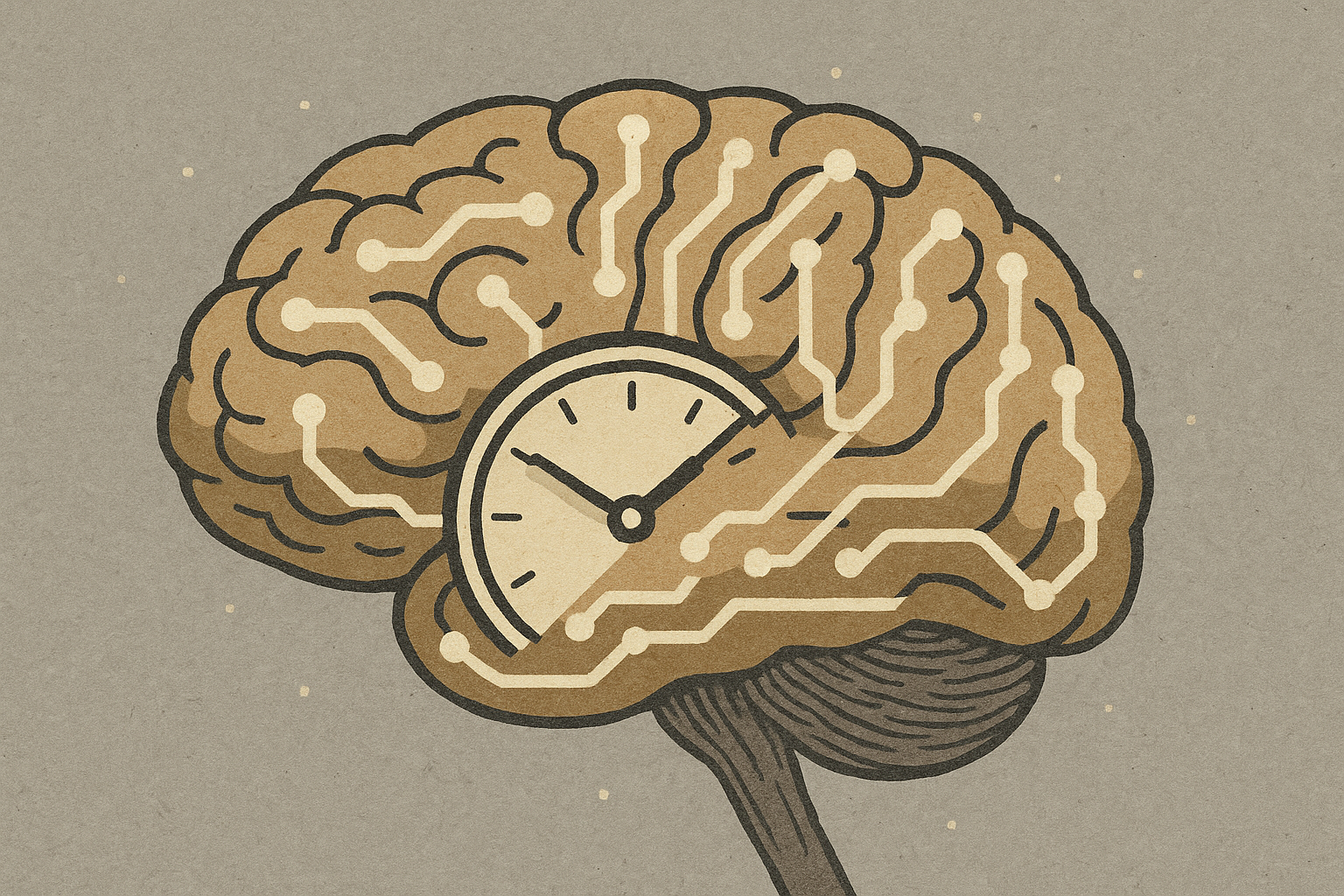
Image via Duskbloom Discovery
Imagine trying to recall what you did last Tuesday. Chances are, your brain doesn’t just cough up a list of events—it retrieves them in order. First the coffee. Then the morning meeting. Then lunch with that friend you hadn’t seen in ages. But how exactly does your brain know what happened when?
Scientists have long known that place cells in the hippocampus help track where things happen. But when things happen? That’s been a tougher nut to crack. Until recently.
Meet time cells—neurons in the hippocampus that appear to fire in a sequence, effectively tagging events in time. This discovery is quietly reshaping how neuroscientists understand memory, cognition, and even the nature of conscious experience.
What Are Time Cells, Exactly?
Time cells were first discovered in rodents during a series of experiments where researchers tracked hippocampal activity while the animals performed tasks involving delays. The key finding? Certain neurons would light up not because of a place, action, or object—but simply based on how much time had passed.
These time cells appeared to activate at consistent intervals, suggesting the brain has an internal metronome that marks the passage of time across seconds, and potentially even longer.
In humans, recent work using fMRI and intracranial EEG has confirmed similar time-based activity in the hippocampus. It's still early, but the results are astonishing: time cells may provide the brain’s answer to organizing episodic memory, not just by what and where, but by when.
Why Does This Matter?
Because our memories are more than just a mental scrapbook—they’re chronological.
Episodic memory, which allows you to mentally time-travel through your life, is foundational for everything from storytelling to decision-making. Without time cells, the story of your life might become a jumbled mess.
Here’s the deal:
- People with Alzheimer’s disease often experience confusion about the order of events.
- Those with PTSD may experience fragmented memories that don’t feel anchored in time.
- Patients with temporal lobe epilepsy can report distortions in time perception.
If time cells are disrupted or damaged, could these symptoms be explained—at least in part—by a failing temporal code?
A Clock in the Brain—or Just a Clever Illusion?
Some neuroscientists are still cautious. Are time cells genuinely keeping time, or are they just reacting to changes in task demands, attention, or emotion?
After all, the brain doesn’t have gears and springs. There’s no “clock” in the traditional sense.
But research keeps pointing to temporal coding mechanisms in the brain that don’t rely on a singular clock but instead use network-level dynamics—a kind of symphony of oscillations across multiple brain regions—to encode durations, sequences, and order.
In one study, when rodents waited for a reward over a delay, time cells activated in predictable sequences—even though nothing else was happening. No movement. No new information. Just time.
That strongly suggests these cells aren’t just reacting to stimuli—they’re encoding time itself.
From Time Cells to Treatment?
The practical implications are big. If time cells help structure memory:
- Neuroprosthetics could someday stimulate time cells to help re-sequence broken memories.
- Cognitive therapy could be targeted at restoring a patient’s sense of temporal continuity.
- AI memory systems may even use time-cell-inspired algorithms to improve time-based event logging.
Some labs are already experimenting with deep brain stimulation in areas near the hippocampus to help treat memory loss and seizures. Could targeting time-cell circuits be the next frontier?
Time Isn’t Just Ticking—It’s Mapped
The more we look, the more it seems the brain doesn’t just passively sense time. It constructs it.
Every moment in your life may be mapped onto a neural timeline made possible by time cells. These cells may stitch together the flow of your experience, creating a mental film reel where you’re both director and viewer.
And if that’s true, then understanding time cells isn’t just about fixing memory. It’s about decoding how we experience life itself—as something unfolding, meaningful, and continuous.
Want to go deeper? Check out this review on time cells and episodic memory from Nature Reviews Neuroscience.
Stay tuned for the next article: Synthetic Embryos Without Sperm or Egg: Are We Rewriting the Origin of Life?
Ad Placeholder
Article Inline Ad
Billboard
More from Science

Why Earth’s Magnetic Field Might Be About to Flip (And What That Actually Means)
By The Duskbloom Media Team
Synthetic Embryos Without Sperm or Egg: Are We Rewriting the Origin of Life?
By The Duskbloom Media Team
What Voyager 1 Just Pulled Off at 15 Billion Miles Away
By The Duskbloom Media Team